Product / MSc Final Project
Outdoor music festivals are unique events given that they are, for the most part, bounded and ticketed, and alcohol is served. They frequently have a higher incidence of patient presentations when compared with similar types of mass gatherings.
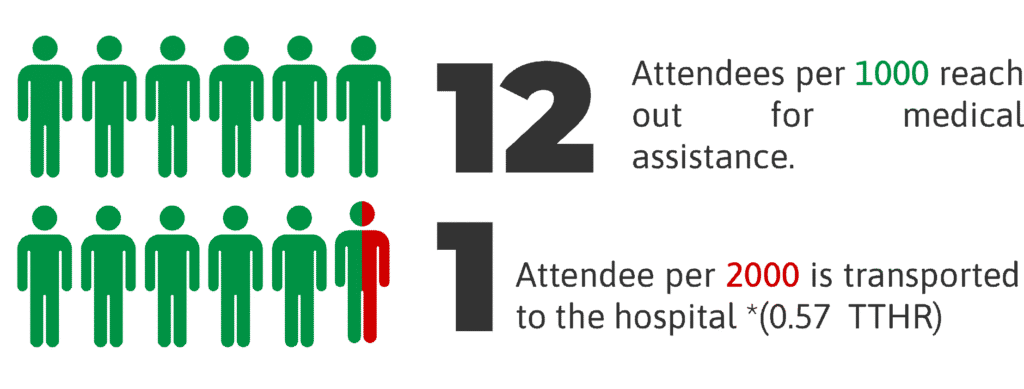
Patient presentation rate (PPR) is defined as the number of patient encounters per 1,000 estimated attendees. Transport-to-hospital rate (TTHR) is defined as the number of patients transported to the hospital by ambulance per 1,000 estimated attendees.
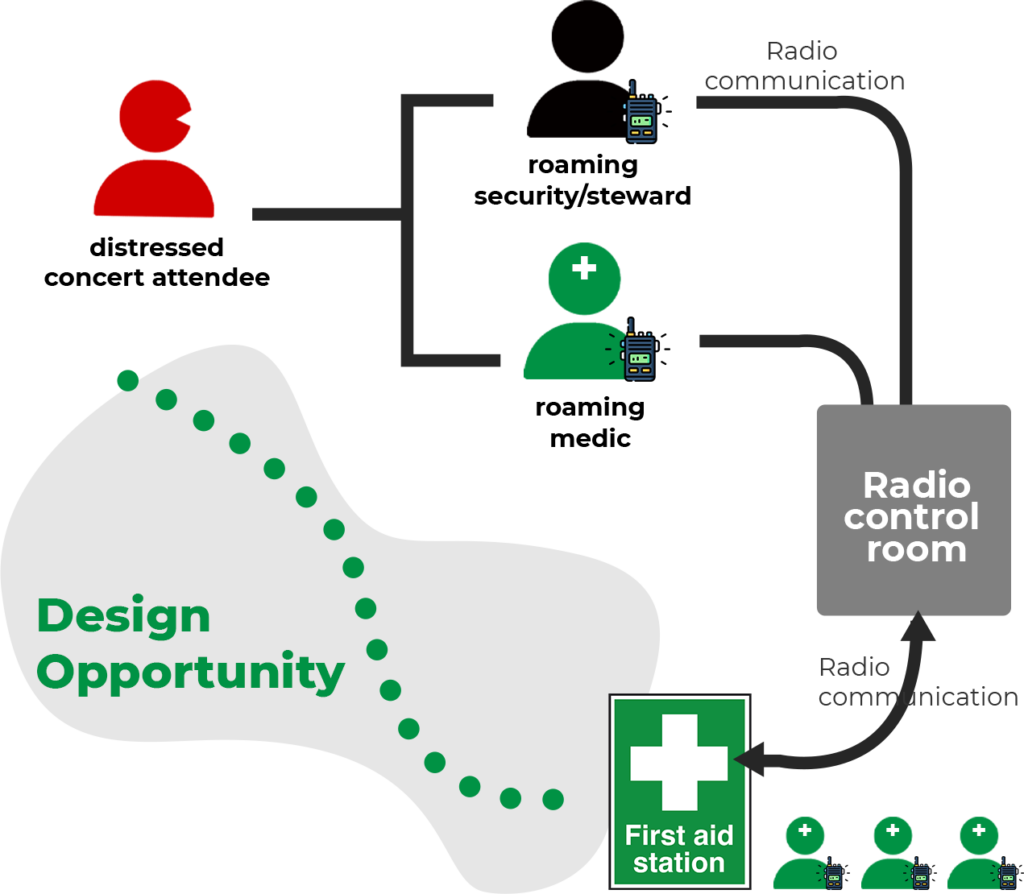
How does an attendee communicate their discomfort to the on-site medical service?
Stewards
- Despite the presence of signage, attendees still encounter difficulties with wayfinding.
- Many attendees arrive before stewards and end up standing for prolonged periods. As a result, a common issue that arises is leg cramps and swelling among many individuals.
Medics/ First – Aiders
- The medical team is divided into two groups: the Stationary Team and the Mobile Team. The Stationary Team remains stationed at the medical station, while the Mobile Teams are dispersed throughout the event to identify potential risks.
- All members of the medical team maintain a continuous line of communication through a centralized and coordinated radio channel.
- For larger events, attendees use “what3words” to pinpoint the location of injured attendees.
Severity level and Triage system
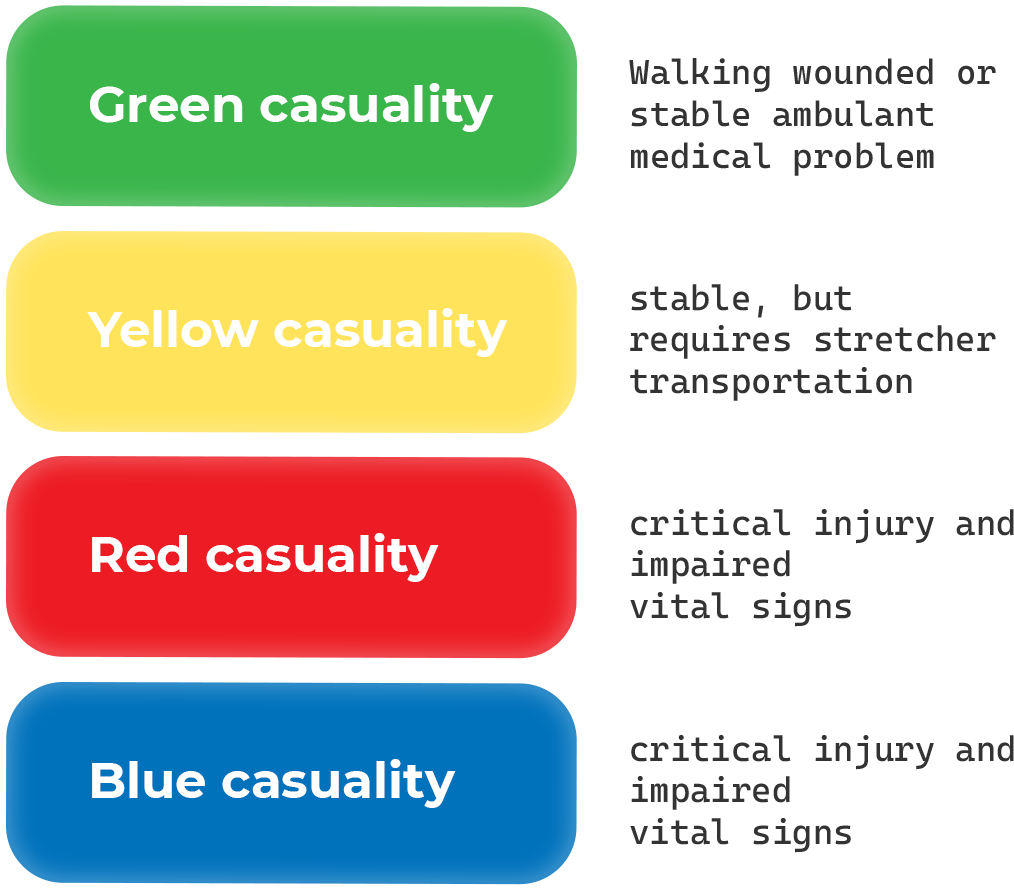
Severity level and Triage system

| GNSS |
| Wi-Fi |
| BLE |
| UWB |
| Zigbee |
| Lora |
| It should generate location (Accuracy 2-5 m) |
| Its should tranfer the location to medicine team (server) |
| It should interact with other devices |
| The system should handle few thousand devices |
| It should consume minimum power (Should last for atleast a day) |
| It should have minimum cost (used as service for thousand of people) |
The requirement for precise location accuracy is generally met by most of the technologies that have been considered. However, the challenge lies in transferring this data, which necessitates a server. Among the technologies considered:
Wi-Fi satisfies most requirements but is not energy efficient.
Zigbee has the potential to communicate without relying on a central server, thanks to its mesh network capability that can encompass thousands of devices. Nevertheless, managing and maintaining such a network could be complex and unwieldy.
Any technology being considered would need to work in conjunction with Wi-Fi to facilitate communication with the central server.

Solution and its direction
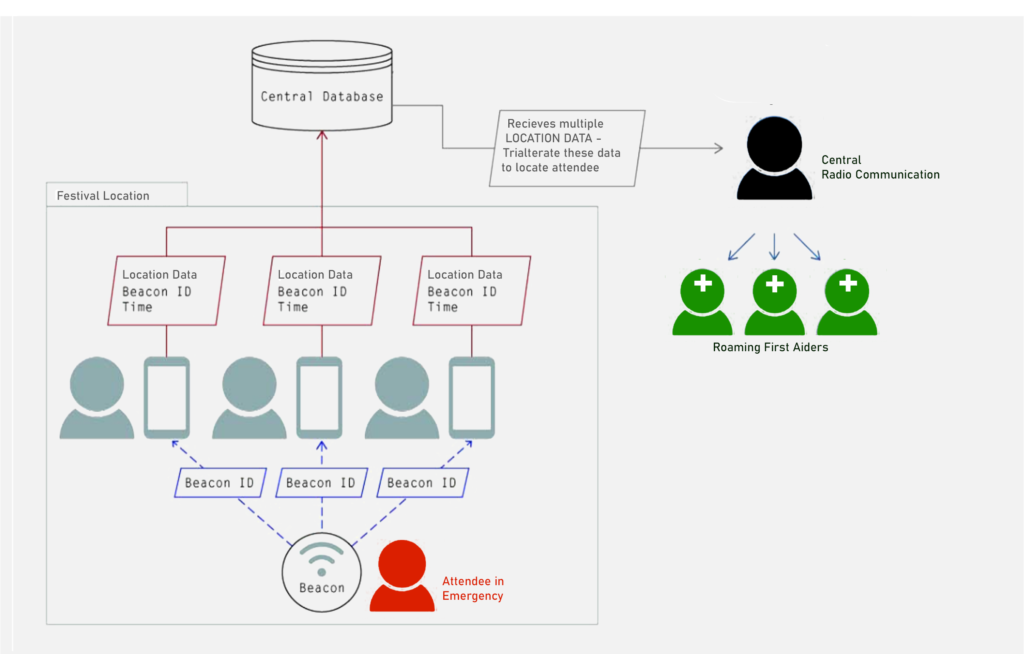
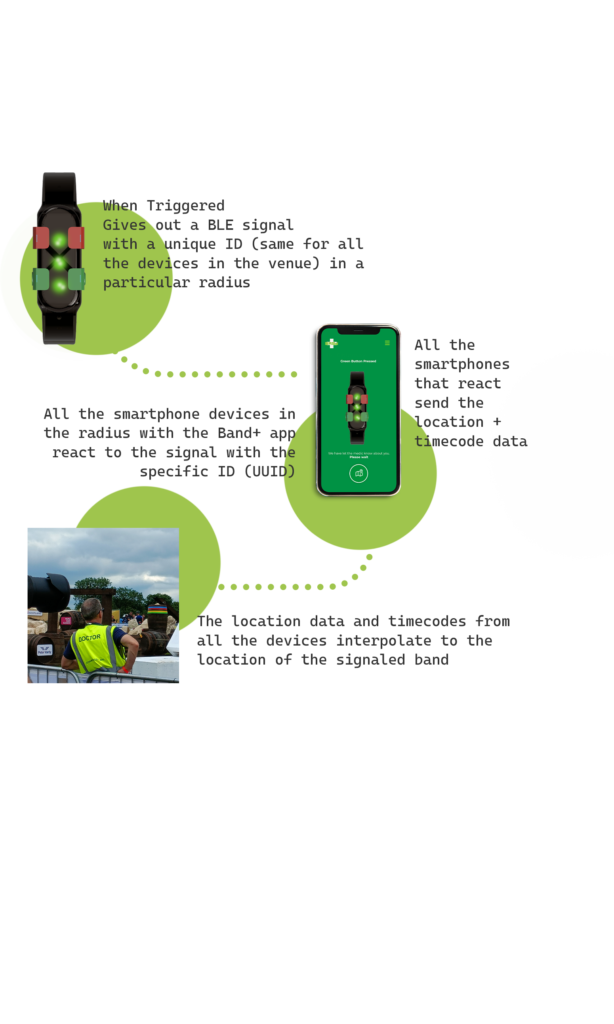
What if the responsibility of passing the location data was outsourced to the smartphone via a common app. Smartphones possess the required technologies and would be owned by all the attendees.BLE(Bluetooth Low Energy) Beacons are used to interact with mobile apps without pairing with them. when the app receives a unique signal from BLE, it pushes a specified action.
How would it work?